

Centimeters to Kilometers Made Simple: The Everyday Conversion Guide
Kurz zusammengefasst
- Converting centimeters to kilometers is simpler than it
- Dieser Artikel erläutert die wichtigsten Erkenntnisse hinter "Centimeters to Kilometers Made Simple: The Everyday Conversion Guide".
- Die Artikel-Metadaten enthalten eine Veröffentlichungs- und Pflegetimeline für besseren Kontext.
Autor: OhToolBox Team
Entwickler und Content Creator mit Leidenschaft für nützliche Online-Tools.
OhToolBox wird mit modernen Webtechnologien entwickelt, damit das Erlebnis stabil, reaktionsschnell und sicher bleibt. Wir verbessern Leistung, Lokalisierungsqualität und Tool-Abdeckung fortlaufend auf Basis realer Nutzungsbedürfnisse.
Converting centimeters to kilometers is simpler than it sounds. The rule comes down to one number: 100,000. Divide your centimeters by 100,000, and you get kilometers. That is the whole formula. In this guide, we will walk through how it works, share some mental math tricks, and show you real-world situations where this conversion actually matters.
The Core Formula: How cm and km Connect
Both centimeters and kilometers are built on the meter — the base unit of length in the Metric System (also called the SI system). Everything in the metric system scales by powers of 10, which makes conversions predictable and easy.
Here is the chain connecting the two units:
| Einheit | Relationship |
|---|---|
| 1 meter | = 100 centimeters |
| 1 kilometer | = 1,000 meters |
| 1 kilometer | = 100,000 centimeters |
So the conversion formula is:
km = cm / 100,000
Or equivalently, multiply by 0.00001 (which is 1 / 100,000). As confirmed by NIST standards verified in 2026, this factor is exact — no rounding needed.
Quick Example
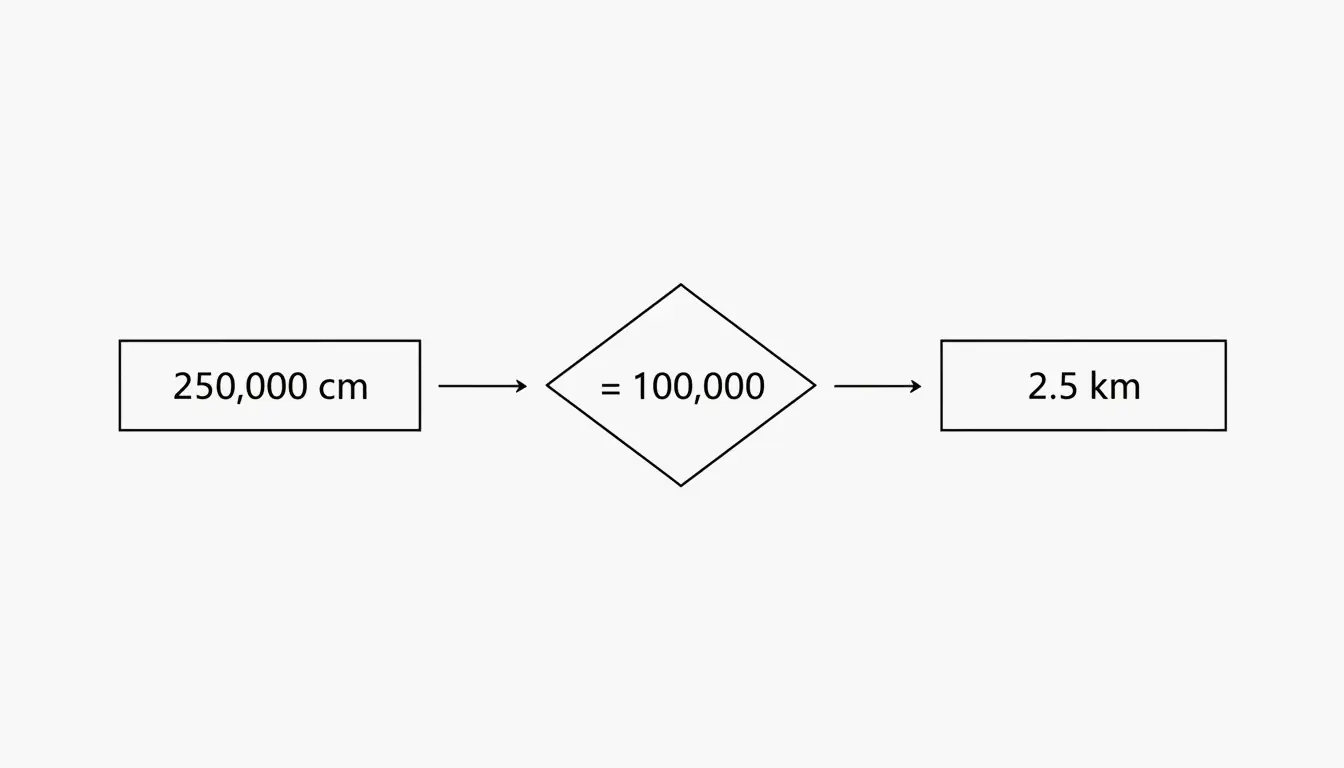
You have a measurement of 250,000 cm and want to know how many kilometers that is:
- Take your value: 250,000 cm
- Divide by 100,000: 250,000 / 100,000 = 2.5 km
Done. According to Calqro, these are exact decimals, so you never have to worry about rounding errors when staying within the metric system.
The Mental Math Shortcut: Move the Decimal 5 Places
Here is a trick that saves you from reaching for a calculator. Since 100,000 has five zeros, converting from centimeters to kilometers is just a matter of moving the decimal point five places to the left.
Let us try it with 90,000 cm:
- Start with the number: 90,000.0
- Move the decimal left one place: 9,000.0
- Move it again: 900.0
- Again: 90.0
- Again: 9.0
- One more time: 0.9
So 90,000 cm = 0.9 km. Data from CoolConversion confirms this result.
This trick works in reverse too. To go from kilometers to centimeters, move the decimal five places to the right. So 0.9 km becomes 90,000 cm.
When Would You Actually Use This?
You might be surprised how often this comes up in daily life:
- Planning a road trip: Your car’s trip computer might show distance in kilometers, but a product specification lists a cable length in centimeters.
- Home improvement: A garden hose is 1,500 cm long — that is 0.015 km, or about 15 meters.
- School projects: Students often encounter both units in science and geography assignments.
Converting in the Other Direction: Kilometers to Centimeters
To go from kilometers back to centimeters, simply multiply by 100,000 (or move the decimal five places to the right).
| Kilometers | Calculation | Centimeters |
|---|---|---|
| 1 km | 1 x 100,000 | 100,000 cm |
| 2.5 km | 2.5 x 100,000 | 250,000 cm |
| 0.9 km | 0.9 x 100,000 | 90,000 cm |
| 8.848 km | 8.848 x 100,000 | 884,800 cm |
Real-World Scale: Understanding the Size Gap
To really appreciate how different centimeters and kilometers are, it helps to look at some familiar examples:
| Example | In Kilometers | In Centimeters |
|---|---|---|
| A standard pencil | 0.000019 km | ~19 cm |
| A football field | ~0.091 km | ~9,144 cm |
| The Three Gorges Dam (Wikipedia) | ~2.3 km | ~230,000 cm |
| Mount Everest height | 8.848 km | 884,800 cm |
| The Karman Line (“edge of space” – Wikipedia) | 100 km | 10,000,000 cm |
Notice how quickly the numbers get unwieldy in centimeters once you move beyond everyday objects. That is exactly why we switch to kilometers for larger distances — the numbers stay readable.
Scientific Notation: The Professional Way
In science and engineering, writing out long strings of zeros can lead to typos. That is where scientific notation comes in. The conversion factor is written as:
1 cm = 1 x 10^-5 km (or 0.00001 km)
This follows ISO 80000-3 standards, which set the global rules for measuring space and time quantities. CoolConversion notes that these factors are checked against BIPM and ISO 80000-3 guidelines (last reviewed March 2026) to keep global trade and research consistent.
For most everyday situations, though, you do not need scientific notation — just remember “divide by 100,000” and you are set.
Area Conversions: Square Centimeters to Square Kilometers
When you move from length (one dimension) to area (two dimensions), the conversion factor gets squared. Since the length factor is 100,000, the area factor is:
100,000 x 100,000 = 10,000,000,000 (ten billion)
The formula becomes:
km^2 = cm^2 / 10,000,000,000
According to CoolConversion, 1 cm^2 = 1 x 10^-10 km^2. This is mostly used in specialized fields like satellite mapping or land surveying. For everyday purposes, you would never measure a city in square centimeters — the numbers would be impossible to read.
A Handy Reference Table
| What You Want | What to Do | Example |
|---|---|---|
| cm to km | Divide by 100,000 | 500,000 cm = 5 km |
| km to cm | Multiply by 100,000 | 3 km = 300,000 cm |
| cm to m | Divide by 100 | 250 cm = 2.5 m |
| m to km | Divide by 1,000 | 2,500 m = 2.5 km |
| cm^2 to km^2 | Divide by 10,000,000,000 | 1,000,000,000 cm^2 = 0.1 km^2 |
Conclusion
Converting centimeters to kilometers boils down to one simple rule: divide by 100,000. The metric system’s base-10 design makes this easy, whether you are using a calculator, doing mental math by shifting the decimal, or applying scientific notation for a technical report. For everyday tasks, just remember that 100,000 cm always equals 1 km. Bookmark this guide or save the reference table above for the next time you need a quick conversion.
FAQ
How many kilometers are in 1 centimeter?
There are 0.00001 kilometers in 1 centimeter. In scientific notation, this is expressed as 1 x 10^-5 km. This exact factor is defined by international standards (SI) and is used globally for technical precision.
What is the easiest way to convert cm to km without a calculator?
Use the “decimal shift” method. Move the decimal point five places to the left. For example, 500,000.0 cm becomes 5.0 km after shifting the decimal five places. No math required.
Are centimeters and kilometers part of the Imperial or Metric system?
Both are units of the Metric System (also known as the International System of Units or SI). The metric system is used globally for science, medicine, and most international trade. The Imperial system uses units like inches and miles instead.
When should I use centimeters vs. kilometers?
Use centimeters for small, everyday measurements (a phone screen, a book, a piece of furniture). Use kilometers for distances between places (city to city, a hiking trail, a marathon route). If the number in centimeters gets hard to read, it is probably time to switch to kilometers.
How do I convert square centimeters to square kilometers?
Divide the number of square centimeters by 10,000,000,000 (ten billion). For example, 5,000,000,000 cm^2 equals 0.5 km^2. This type of conversion is mostly used in mapping, geography, and land surveying.